Greece tours turn a long wish list into a clear plan. This page sorts Greece tours by region and by type, from the Acropolis in Athens to boat days around Santorini, Crete and Corfu.
Each section below names the tours that start in one place and shows booking cards you can open on GetYourGuide. Read the section for your trip, compare the tour types, then book the date that fits. To see how this site works, read about us.
What Exactly Do You Book When You Reserve Greece Tours?
When you reserve Greece tours, you book a bundle of services sold together as one booking. A package tour joins items such as transport and outings, and a tour operator sells the bundle. The tour page lists what the bundle covers and what it leaves out. Read that list before you pay, then compare it with your plans.
Look for three items in the included list on Greece tours: transport, entry tickets, and a tour guide. A tour guide explains the sights in the language you choose. The platform says the total shown must cover every mandatory fee for the main itinerary, such as entrance tickets. Items marked not included are yours to arrange.
Greece tours with a set start time run for a set length. The voucher shows a meeting point or a pickup description, so you know where to join your group. It adds a map when the operator pinned an exact spot. Without an exact spot, no map appears, so use the written description. Arrive before the start time.
Greece tours come in two group formats, private and shared. A private tour runs on your clock, with only your group and the tour guide. On a shared tour, you join other travelers, and the tour guide sets the route and timing. The platform labels a day trip as small group only at 15 people or fewer.
Greece tours offer both self-paced and expert-led visits. A mobile audio guide plays recorded commentary, and you can pause it or skip stops. An expert-led visit adds a tour guide who explains the heritage of the place in person. Discover Greece says only graduates of a two-year state school can lead tours at historical and cultural sites.
Read four lines on every tour page before you book Greece tours. Duration comes first. The platform labels half-day tours 4 to 7 hours and full-day tours 8 hours or more. Next come the languages the tour runs in, then the included and excluded lists. Last, read the cancellation terms, which must match the tour’s policy.
After you pay, the confirmation for your Greece tours arrives with a voucher. It holds the traveler names, the tour name, the start date, and what is included. It also lists the operator’s phone and email. The voucher fields change with how the operator set up the tour. The sender and booking reference show which platform handled it.
Where On The Map Do Greece Tours Run?
Greece tours run on the mainland and on islands in the Aegean and Ionian seas. Greece is a peninsular country with an archipelago of about 3,000 islands. This page sorts the tours by region, so you can match each one to a spot on the map. It lists city tours, mainland day trips, and island cruises.
Greece has 13 administrative regions. The north of the mainland holds Macedonia and Thrace. To the south, the land narrows into Epirus, Thessaly, and Central Greece. The Peloponnese is a peninsula, and the Isthmus of Corinth ties it to the mainland. Land borders touch Albania, North Macedonia, Bulgaria, and Turkey. Mainland Greece tours start in these regions.
Mountains shape the map: 80% of Greece is mountainous. The Pindus is the largest range, and people call it the spine of Greece. Mount Olympus is the tallest mountain in Greece, at about 2,918 meters, or 9,573 feet. It stands on the border of Thessaly and Macedonia. Use these peaks as landmarks for the Greece tours below.
Greece has the longest coastline in the Mediterranean basin, at 13,676 kilometers, or 8,498 miles. The Aegean Sea lies to the east, and Turkey sits across it. To the west, the Ionian Sea sits between Greece and Italy. The Mediterranean Sea borders the country too. Island cruises among the Greece tours here sail on these seas.
The number of Greek islands depends on who counts them. Estimates run from around 1,200 to 6,000, based on the smallest size you include. One figure from travel books is 1,425 islands, with 166 said to be inhabited. Other counts of inhabited islands go up to 227. Island groups make Greece tours easier to sort than single islands.
The Cyclades, southeast of the mainland, hold about 220 islands and islets. The Dodecanese have 26 inhabited islands. The Ionian Islands are seven main islands west of the mainland. The Saronic Islands lie just off the mainland. The Sporades have 24 islands, four permanently inhabited. The North Aegean region names nine islands. Each group has its own section.
The map decides how a trip works. Each tour starts from a base town, and that town sets the part of the map you visit. Pick the base first, and the sights around it follow. The sections below sort Greece tours by region, from Athens to the island groups. Read the map, then choose your region and tour.
Which Greece Tours In Athens Visit The Acropolis And The Ancient Agora?
Greece tours in Athens visit the Acropolis, the Acropolis Museum, and the Ancient Agora. These sights sit around one rock. The rock rises 150 meters above sea level. The museum stands by its southeastern slope, and the Agora lies northwest. Guided Acropolis tours, skip-the-line ticket tours, and walking tours are listed as cards on this page.
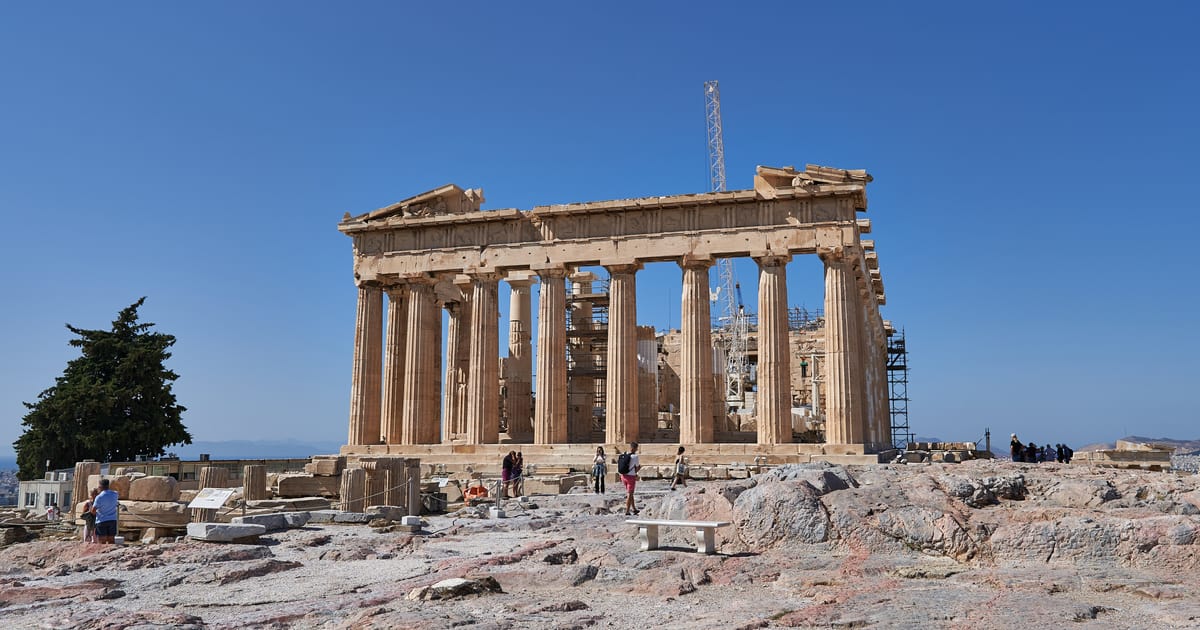
Guided Acropolis tours are among the Greece tours on this page. The rock covers about 3 hectares. The Parthenon, the Propylaea, the Erechtheion, and the Temple of Athena Nike stand on it. The Parthenon was a temple of the goddess Athena. Builders began it in 447 BC and finished it in 438 BC. The Acropolis has two entrances.
Acropolis Museum tours are Greece tours of a building at the foot of the hill. The museum holds more than 4,250 objects across 14,000 square meters. Glass floor sections let you see the excavated ruins below. The third-floor gallery was specially designed for the Parthenon sculptures. The museum sells its own timed-entry ticket, apart from the Acropolis.
Walking Greece tours also reach the Ancient Agora, northwest of the Acropolis. People first used it for trade, assembly, and housing. The Bouleuterion was the city’s assembly building. The Temple of Hephaestus is a Doric temple that still stands largely intact. The Stoa of Attalos, a shop-lined hall from the 2nd century BC, now holds the Agora museum.
Greece tours in Athens cover Plaka, the old neighborhood on the Acropolis’s northern and eastern slopes. Its twisting streets pass neoclassical houses. The Temple of Olympian Zeus is about 500 meters southeast of the rock. It once had 104 columns, and fifteen still stand. The Panathenaic Stadium stands alone as a stadium built entirely of marble.
Greece tours of Athens follow set patterns. Walking tours link sights on foot. Ticket tours handle the timed entry the Acropolis requires. That ticket also covers extra sites at the foot of the hill. A hop-on hop-off bus lets you get on and off at the Acropolis. Evening walks fit Plaka, where traditional Greek evenings are spent.
Athens is the capital and largest city of Greece, in the Attica region. People have lived here for at least 5,000 years. Other Greece tours start from Athens as day trips to sites outside the city. Other sections of this page list those day trips. Plan your city sights first, then choose a trip from the cards.
Which Greece Tours From Athens Reach Delphi, Mycenae, Epidaurus And Cape Sounion?
Greece tours from Athens reach Delphi, Mycenae, Epidaurus, Nafplio, Corinth, Cape Sounion, and Ancient Olympia by road. The cards on this page list Delphi, Mycenae-Epidaurus-Nafplio, Corinth, and Ancient Olympia day trips. Cape Sounion sunset tours are listed too. Each paragraph below covers one stop, so you can match a tour to the sites you want.
Delphi sits on the southwestern slope of Mount Parnassus in central Greece. Its oracle, the Pythia, was consulted about important decisions across the classical world. Greece tours to Delphi lead to the Temple of Apollo ruins from the fourth century BC. The museum holds the Charioteer of Delphi. Its collection also includes the earliest known notation of a melody.
Mycenae lies about 120 kilometers southwest of Athens. It is 11 kilometers north of Argos. Greece tours to Mycenae enter the citadel through the Lion Gate. Later Greeks thought one-eyed giants, the Cyclopes, built its massive walls. Grave Circle A holds six royal shaft graves. The Treasury of Atreus is the largest of the nine dome tombs.
Epidaurus was an ancient healing center where ill people went hoping for a cure. On Greece tours to Epidaurus, you reach a theater that seats up to 14,000 people. Polykleitos the Younger designed it in the fourth century BC. Nafplio, 147 kilometers from Athens, was the first capital of modern Greece. You can walk its old town.
The Corinth Canal is 6.4 kilometers long and has no locks. It cuts through the Isthmus of Corinth. It separates the Peloponnese from the mainland. Corinth day trips appear among the Greece tours on this page. Ancient Corinth lies about 5 kilometers from the modern city. Seven columns of its Temple of Apollo still stand on a hill.
Greece tours to Cape Sounion reach the southernmost tip of the Attica peninsula. It is 69.5 kilometers southeast of Athens. Its Temple of Poseidon has the Aegean Sea on three sides. Of the 34 original Doric columns, 15 still stand today. The sunset seen from the ruins has been a sought-after sight since the early 19th century.
Greece tours to Ancient Olympia reach the birthplace of the Olympic Games. The modern Olympic flame is lit there. Its Temple of Zeus held a Pheidias statue named one of the Seven Wonders of the Ancient World. The bus from Athens to Olympia takes four to four and a half hours. The Delphi bus takes about three hours.
How Do Greece Tours To Meteora Work From Athens And Thessaloniki?
Greece tours to Meteora take you from Athens or Thessaloniki to a group of rock monasteries in central Greece. The cards on this page list day trips from Athens, sunset tours, bus trips from Thessaloniki, and visits to monasteries. All of them center on the same place: tall sandstone peaks with monasteries perched on top of them.
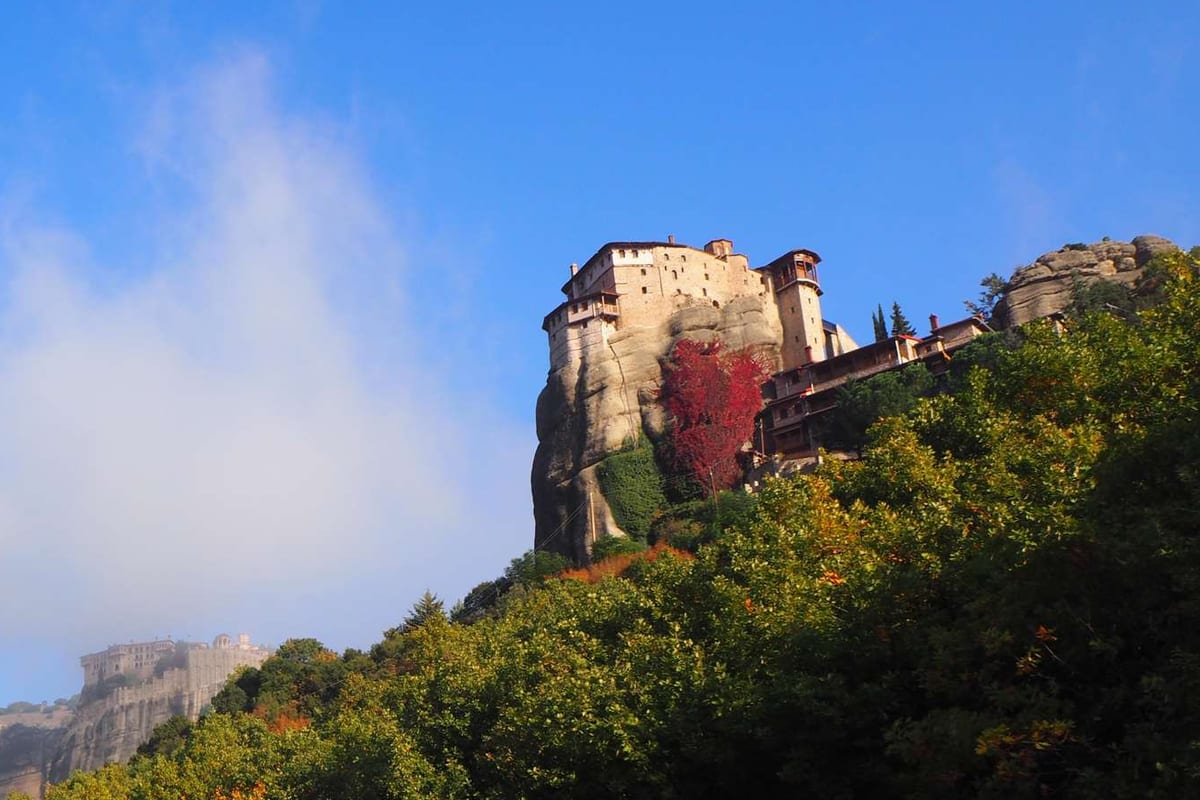
UNESCO lists Meteora as a Mixed World Heritage Site. That means Greece tours here visit a place valued for both culture and nature. The name means “suspended in the air” in Greek. The sandstone peaks rise over 400 meters above ground level. They formed 60 million years ago from river deposits, and earthquakes, rain, and wind carved them.
Monks settled here from the 11th century, and by the end of the 15th there were 24 monasteries. Six are open to visitors: Great Meteoron, Varlaam, Agios Stefanos, Agia Triada, Rousanou, and Agios Nikolaos Anapafsas. Steps lead up to five of them, and a bridge reaches Agios Stefanos. Expect steps on Greece tours with a monastery visit.
Greece tours to Meteora go to the northwest edge of the Thessaly plain. The town of Kalambaka lies at the foot of the rocks, on the left bank of the Pinios River. Kastraki is a village on the west side of the rocks. Kalambaka has better amenities and easier transit, while Kastraki sits closer to the rocks.
The monasteries ask for tops that cover the shoulders, long trousers for men, and long skirts for women. Each monastery closes one day a week in summer, and the days vary. Great Meteoron closes on Tuesday, Varlaam on Friday, and Agios Stefanos on Monday. Winter days change, so check the closing day before you choose Greece tours.
The drive from Athens to Meteora covers roughly 350 kilometers and takes about 4 to 4.5 hours. Intercity buses take approximately 4.5 to 5 hours. Meteora day trips from Athens and Meteora sunset tours are listed as cards on this page. Compare the pickup time and the return time on the Greece tours from Athens before you book.
From Thessaloniki, the road to Meteora covers about 230 kilometers and takes around 2.5 to 3 hours by car. Intercity buses take about 3 to 3.5 hours. That is shorter than the trip from Athens in both cases. Meteora from Thessaloniki by bus and Greece tours with a monastery visit are listed as cards on this page.
Which Greece Tours Sail The Saronic Gulf From Athens?
Greece tours on the Saronic Gulf leave from Athens and call at Aegina, Poros, Hydra, or Agistri. The gulf lies between the Attica and Argolis peninsulas, so these islands sit close to the capital. Tours of this kind are listed as cards on this page. You can pick a single island or link three in one day.
Piraeus is the Athens port for Greece tours on the Saronic Gulf. It lies on the northeastern edge of the gulf, 8 kilometers southwest of central Athens. It is the largest port in Greece, with ferry routes to nearly every island in eastern Greece. The Saronic islands are a short ferry ride away, so day trips are popular.
Aegina lies 17 miles from Athens. The main sight for Greece tours here is the Temple of Aphaia. It dates to about 500 BC and stands on a hill 160 meters high. Aphaia was a goddess worshipped only at this sanctuary. The temple is exceptionally well preserved. Aegina also grows pistachios with a Protected Designation of Origin label.
Hydra is the car-free island on Greece tours of the gulf. By law, cars and motorcycles are not allowed there. You get around on foot, by donkey, or by water taxi. The harbor has a crescent shape, and steep stone streets climb away from it. Fast hydrofoils and catamarans link Hydra with Piraeus, 37 nautical miles away.
Poros lies in the southern Saronic Gulf, separated from the Peloponnese by a channel 200 meters wide. Its clock tower is the main sight in town. Agistri is a small island covered in pines, about an hour by boat from Piraeus. Its beaches Aponissos and Dragonera face west. Agistri cruises are part of these Greece tours.
Island cruises in the gulf follow four formats. A one-island trip spends the day in one place. A three-island day cruise links Aegina, Poros, and Hydra. A speedboat trip uses a small, fast boat. A luxury cruise with meals serves food on board. Read the stop list on each card to see which of these Greece tours fits.
On these Greece tours, a swim stop means the boat pauses so you can swim. A free-time stop means you go ashore and explore on your own. Hydra’s one good swim spot near town is the rocky shore called Spilia. The Aegina temple is a bus ride from the port, so check each stop’s length.
Which Santorini Greece Tours Cover The Caldera, The Volcano, Wine And Sunset?
Santorini Greece tours cover all four: the caldera, the volcano, the wine and the sunset. Boat tours reach the water inside the caldera and the volcanic islands. Land tours reach the rim villages, the ruins and the wineries. A sunset tour ends the day at the cliffs. Cards for each kind of tour sit on this page.
The caldera is a large crater filled with sea water. It began when a round island collapsed after its magma chamber emptied. The Minoan eruption, about 3,600 years ago, broke the ring of land in two places. The inner cliffs drop over 300 meters at their highest. Caldera cruises in these Greece tours sail below that wall.
Nea Kameni, the new burnt island, sits in the middle of the caldera. A gravel path climbs the 130-meter crater, and you can walk its rim. Steam and sulfur vents show the volcano is alive. Palea Kameni, the old burnt island, has a hot spring. Volcano and hot springs boat tours are listed here among these Greece tours.
Three villages stand on the caldera rim. Fira, the island capital, sits above its port, and a cable car links the two. Imerovigli lies north of Fira on the rim, crossed by narrow paved paths. Oia stretches almost 2 kilometers along the northern edge of the caldera. Sightseeing Greece tours visit rim villages like these.
Akrotiri is a Bronze Age town that volcanic ash buried and preserved. Walls stand up to 8 meters high under a giant canopy. Red Beach lies near Akrotiri, with red sand and iron-rich cliffs. Kamari has black sand, and White Beach is reached only by sea. Greece tours with a beach stop use the outer coast.
Santorini grows the Assyrtiko grape, which is native to the island. Growers train the vines into low spiral baskets that shield the grapes from wind. The white wines are very dry, with a citrus scent and mineral aromas from the ashy soil. You can tour wineries in Megalochori and Pyrgos, and wine tours join these Greece tours.
Each of these Greece tours builds on one of the sights above. A catamaran cruise sails around the caldera. A volcano boat trip follows the routes between Fira, Nea Kameni and Palea Kameni. A sightseeing tour links villages and ruins. A wine tour stops at wineries. A sunset tour waits for dusk, when Oia draws crowds.
Which Greece Tours Run On Mykonos, Delos, Naxos, Paros And Milos?
Greece tours reach all five of these Cyclades islands in the Aegean Sea: Mykonos, Delos, Naxos, Paros and Milos. Mykonos and Delos have cruises, Milos has boat tours around its coast, and Naxos and Paros have day tours. Each island brings its own sight, from windmills and ancient ruins to a stone gate and white cliffs.
Mykonos Town, also called Chora, is the island’s port town and capital. Its whitewashed houses and churches gather around the harbor. The Venetians built the windmills here in the 16th century. Stairs lead down to Little Venice, where fishing houses hang balconies over the sea. Greece tours with a Mykonos cruise are listed on this page.
Delos, a tiny island southwest of Mykonos, is a UNESCO World Heritage Site. Apollo was born there, says UNESCO, and pilgrims came from across Greece. Greece tours to Delos go by boat from Mykonos and take about 30 minutes. Boats run daily except Monday, when the site closes. The Naxians dedicated the Terrace of the Lions to Apollo.
Naxos is the largest Cyclades island, and its capital, Naxos Town, is also called Chora. Only the Portara gateway survives from a temple of Apollo, and you can see it from the harbor. The Venetians built the walled Kastro quarter in the early 13th century. Naxos day tours belong to the Greece tours on this page.
Parikia, the capital of Paros, sits on a north-west bay. Its church, the Panagia Ekatontapiliani, means church of the hundred doors. Naoussa, on the north side, is an old fishing village with a Venetian port. White, translucent marble was once the main source of wealth on Paros. Boat trips around the island reach Antiparos and other nearby islands.
Greece tours for Milos are boat tours around the coast of a volcanic island. Sarakiniko has smooth white rock sculpted into wave-like shapes. Kleftiko has white sea caves and tall rock arches, once a pirate hideout. You reach Kleftiko mainly by boat. A farmer found the Venus de Milo here, and it now stands in the Louvre.
Greece tours in the Cyclades are built around the sea. Overnight stays on Delos are forbidden, so a Delos boat trip is a day trip. Cruises to Delos and Rhenia add the island across a narrow channel. A Mykonos cruise with a meal joins a boat ride and a table. A Milos boat tour runs around the coast.
Which Greece Tours Cover Knossos, Spinalonga, Balos And Samaria On Crete?
Greece tours on Crete cover Knossos, Spinalonga, Balos and the Samaria Gorge. Each place has its own tour type. You can book a Knossos tour, a Spinalonga day trip, a Balos and Gramvousa cruise, or a Samaria Gorge hike. Olive oil tastings are listed as cards on this page too. The paragraphs below explain each stop in turn.
Crete is the largest island in Greece and the fifth largest in the Mediterranean. It stretches 260 km from west to east. Knossos lies about 5 km south of Heraklion’s historic center. Heraklion is the capital, on the north shore. Scholars read the Minoan palace as a religious and ceremonial center. Greece tours of Knossos cover the ruins.
The Heraklion Archaeological Museum stands in the town center. It houses the bulk of the Minoan finds from Knossos and other sites. Chania has a largely intact old town beside its Venetian harbor. Rethymno, between Heraklion and Chania, has a well-preserved old town below a massive Venetian fortress. Greece tours of these towns are listed here.
Spinalonga is a rocky island at the mouth of the Gulf of Elounda, in northeast Crete. The Venetians kept it as a fortress for centuries. Later it became a leper colony, and the first 251 people with leprosy arrived there. Tourist boats leave for it from Plaka, Elounda and Agios Nikolaos. Greece tours of Spinalonga are day trips.
Gramvousa is a pair of small uninhabited islands off northwest Crete. A Venetian fort stands in ruins on Imeri Gramvousa. The Balos lagoon lies between it and the Cretan coast. Elafonisi, near the southwest corner of Crete, is a protected nature reserve with pink sand. Greece tours that sail to Balos and Gramvousa are listed here.
The Samaria Gorge is a national park in the south of Chania. The gorge is 16 km long. The walk runs from the Omalos plateau to Agia Roumeli on the Libyan Sea. At its narrowest point, the walls close to four meters apart and rise almost 300 meters. Greece tours that hike the gorge are listed here.
The CretAquarium stands near Gournes, 15 km east of Heraklion. It has 61 tanks that hold 1,800,000 liters of water in all. More than 2,500 animals of about 250 species live there. Its Open Sea section shows sharks and turtles from the Mediterranean. Greece tours from Heraklion include a Santorini day trip by boat, listed here.
Which Greece Tours Run On Rhodes, Kos And The Dodecanese?
Greece tours here visit five main stops: Rhodes Old Town, Lindos, Symi, Kos and Nisyros. Rhodes is the largest island of the Dodecanese. Tour cards for each kind of trip appear on this page between the short sections below. Each section tells you what the stop shows, so you can match a card to a place.
The Dodecanese is a group of 15 larger islands and 150 smaller ones, and 26 are inhabited. They lie in the southeastern Aegean Sea, close to the coast of Turkey. The name means twelve islands. Rhodes has led the group since ancient times. Greece tours to Rhodes, Kos, Symi and Nisyros all stay inside this one group.
Rhodes Old Town is a UNESCO World Heritage site inside a wall 4 km long. The Knights of St John built its high town, and their inns line the Street of the Knights. Their Grand Master lived in a palace that is now a museum. Greece tours of the Old Town are listed on this page.
Lindos lies on the east coast of Rhodes, about 40 km south of Rhodes city. Its acropolis is a natural citadel that Greeks, Romans, Byzantines, the Knights and Ottomans each fortified. On top you can see parts of the Doric Temple of Athena Lindia from about 300 BC. Lindos day trips are among the Greece tours listed here.
The island of Symi is about 24 km north of Rhodes. Colorful neoclassical mansions from the mid 19th century cover the slopes near the main town. Symi once had the largest sponge fishing fleet in the world. Cruise boats leave Mandraki Port in Rhodes city for day trips to Symi. Greece tours by speedboat to Symi are listed below.
Kos is the third largest island of the Dodecanese. Hippocrates, called the Father of Medicine, was born on Kos. The Asklepieion lies about 3.4 km southwest of Kos town. In ancient times it was a place of worship, healing and medical teaching. Its ruins stand on three terraces. Greece tours that include Kos appear on this page.
Nisyros is a round volcanic island, about 8 km across, between Kos and Tilos. Its volcano is active but not erupting. You can walk into the crater and see steaming vents. In summer, daily trips to the island leave Kardamena on Kos. Nisyros day trips and Rhodes catamaran cruises are also among the Greece tours listed here.
Which Greece Tours Run On Corfu, Zakynthos And Kefalonia?
Greece tours on Corfu, Zakynthos and Kefalonia run as a cruise, a coach tour or a boat tour. Corfu adds a UNESCO old town and a palace. Zakynthos adds sea caves and a shipwreck cove. Kefalonia adds a white beach and a cave lake. Tours of these kinds are listed as cards on this page.
The Ionian Islands form a chain along the west coast of Greece, in the Ionian Sea. Seven islands count as the main ones. Corfu is the northernmost, and the region is based there. Kefalonia is the largest, Zakynthos the third largest, and Paxos the smallest of the seven. These Greece tours cover Corfu, Zakynthos, Kefalonia and Paxos.
Greece tours of Corfu Old Town cover a UNESCO World Heritage site with clear Venetian influence. The Liston is an esplanade between the town and the citadel. The Achilleion palace stands in Gastouri, about ten kilometers south of Corfu city. It was built for Empress Elisabeth of Austria. Its design suggests an ancient palace of mythical Phaeacia.
Paleokastritsa is a village on the west coast of Corfu, known for its cliffs and nearby beaches. Its monastery houses a museum. Paxos lies about 15 kilometers from the southern tip of Corfu. Greece tours by boat head south to reach it. Antipaxos has three main beaches: Vrika, Mesovrika and Voutoumi. Vrika has white sand.
Zakynthos shipwreck beach boat tours go to Navagio, a cove on the northwest shore. High cliffs isolate it, and the wreck rests in the limestone gravel. Rockfall makes the shore risky, so boat tours view the cove from the sea. Greece tours here are built around that view. Read the card to see what each trip includes.
The Blue Caves are sea caves carved into the cliffs around Cape Skinari, in the north of Zakynthos. The blue water stands out in the morning, when the light is brightest. Kianoun is the biggest cave. You reach the caves by small boat, on a tour or a hired boat. Boats depart from Agios Nikolaos Port and Alykanas.
Greece tours on Kefalonia feature Myrtos Beach and the Melissani cave lake. Myrtos lies in the northwest of the island, between two mountains. Its beach is made of round white cobblestones. A steep road with hairpin turns leads down to it. Melissani is a cave where a limestone collapse exposed the water. You tour it by small boat.
How Do Multi-Day Greece Tours Run From Start To Finish?
Multi-day Greece tours pack sightseeing, hotel nights, and the travel between stops into one booked route. Each one runs for two days or more. You join on day one and follow the plan to the last day. The cards on this page show three route types: the classical circuit, the two-day tour, and island hopping.
A classical circuit links Athens, the Peloponnese, and central Greece in one loop. These Greece tours change hotels as they move from base to base. A wiki for that region advises staying in Nafplio and driving out to one ancient site a day. Check the number of sites planned each day. Ask whether any day is mostly driving.
A two-day Delphi and Meteora tour trims the classical circuit down to two stops. The drive from Athens to Kalambaka, the tourist hub at the foot of the rocks, takes about four hours. Two days means one night away. Greece tours of this type start early on day one, so confirm the pickup time the evening before.
Island-hopping Greece tours move you from island to island by ferry. Each night can be on a different island. A travel wiki calls island hopping very popular in the Cyclades. It suggests the idea for trips of more than one week. Tours of this kind are listed on this page. Count the ferry legs before you book.
On Greece tours, your hotel sits in a base town near the next day’s sites. At Meteora, Kastraki is a small village that sits closer to the rocks and is quieter. Kalambaka has better amenities and easier transit. Pack one soft bag for the nights away. Keep your passport, medicine, and a charger in a small day bag.
These Greece tours follow one daily rhythm. You start early, ride for a long stretch, stop at a site, break for lunch, and ride again. Evenings are free, so you eat dinner on your own. On a long driving day, eat a full breakfast and carry water and a snack. Keep that evening simple and rest early.
Group departures put you with other travelers on a set route. Private departures are for your own party only. Pick a group departure if you like to share the day with others. Pick a private one if you travel as a family or a team. Read the card for each of these Greece tours to see its departure type.
Which Greece Tours Let You Taste Food, Wine And Olive Oil?
You can join Greece tours built around food, wine and cooking. Four kinds are listed as cards on this page: Athens food tours, cooking classes, olive oil tastings and wine tours. The next paragraphs explain the foods behind these tours, from olive oil and feta to coffee and wine. Each card lists its own details.
Olive oil is a vegetable oil pressed from whole olives. Greece is one of the large olive oil producers in the world. National Geographic describes a tasting where guests warm small glasses of oil in their hands. This brings out fruitiness, bitterness and spiciness. Olive oil tastings are listed among these Greece tours.
Feta is a protected cheese in the European Union. Sheep milk makes it, with up to 30% goat milk allowed. In Greece, meze are plates of snacks served with drinks such as ouzo and tsipouro. Greece makes 12,000 tonnes of honey a year. Read the cards of Greece tours that focus on food for their tasting stops.
Greek coffee is brewed in a small pot called a briki. It is served in a thick-walled cup, next to a glass of cold water. The Central Market of Athens, called Varvakeios, stands on Athinas Street. It sells meat, fish, vegetables, sausages, herbs and spices. Check the Athens food cards among these Greece tours for a market stop.
Two mainland wine regions are Nemea and Naoussa. Nemea lies in the Peloponnese and grows Agiorgitiko, which means Saint George’s grape. Naoussa lies in Macedonia and grows Xinomavro, which means sour black. Naoussa wine must be 100% Xinomavro, and the grape’s high acidity and tannin help good bottles age. Look for wine tours among these Greece tours.
Greece tours with a cooking lesson are listed as cards on this page. Spanakopita is a pie of spinach, feta, onion and egg, wrapped in phyllo with olive oil or butter. Phyllo is a very thin dough, and making it at home takes time and skill. Tzatziki is a cold meze of strained yogurt, cucumber, garlic and olive oil.
Food tours are built from stops such as a market walk, a tasting, a cooking lesson or a farm meal. National Geographic names olive oil tastings held in an olive grove and tours of olive mills. A tour lists its own stops on its card. Read each card, then book the Greece tours whose stops match your taste.
How Do You Get Between Greece Tours By Ferry, Flight Or Transfer?
You get between Greece tours by ferry, by plane or by transfer. The Greek ferry network works like a wheel, with Piraeus as the hub and the routes as spokes. Flights are worth a look for trips between the mainland and the islands. Transfers and tours that start after a ferry arrival are listed on this page.
Athens has three ferry ports: Piraeus, Rafina and Lavrio. Piraeus, the main port, sits on the Saronic Gulf. Metro Line 1 ends at a station right beside it. Rafina lies 25 kilometers east of the city center. Lavrio lies about 60 kilometers to the southeast. Check your boat’s port before you plan your Greece tours.
Two kinds of boat leave Piraeus for the Aegean islands: conventional ferries and high-speed catamarans. Fast ferries cut travel times in half. Aegean boats leave from gates E6, E7, E9 and E10. The port is large: one end to the other is a 30-minute walk. Either type gets you to the Greece tours on the islands.
Athens International Airport carries the name Eleftherios Venizelos. It sits near Spata, about 20 kilometers east of central Athens. By road the trip is 30 kilometers, because hills lie in the way. A rail station beside the terminal serves Metro Line 3 and the suburban railway. That link helps with Greece tours that start in the city.
Flying is worth a look for trips between the mainland and the islands. Greece has an extensive network of domestic routes. One Greek airline keeps main hubs at Athens International Airport and in Thessaloniki. A train covers the 506 kilometers between Athens and Thessaloniki. Pick the plane or the train for long hops between Greece tours.
A transfer takes you from the airport or the port to your hotel. Airport express buses run 24 hours between Piraeus port and the airport. Taxis wait at exit 3 of the airport arrivals level. Unlicensed drivers meet arriving ferries, so choose a licensed cab. Airport and port transfers sit beside the Greece tours on this page.
Plan every tour around your ferry time. Ferries leave on time, so be prompt. Popular sailings sell out in high season and on holiday weekends. Schedules are posted at the ticket offices in the departure ports. Allow plenty of time. Strikes and breakdowns can delay a boat, so leave a gap before any of your Greece tours.
Which Season Fits Greece Tours Of Each Type?
Late spring, June, September, and October fit Greece tours of every type. The weather in those months is pleasant, while July and August run hot. Winter is cool and wet. City walks, ruin visits, boat days, hikes, and island trips each have a season that suits them. This part matches each type to its own season.
Greece has a Mediterranean climate, with hot, dry summers and near-constant sunshine from April to November. The cool, rainy period starts in November and lasts until late March or early April. In Athens, December gets about 76 millimeters of rain, and August gets about 5. Greece tours that climb into the inland mountains meet a cool alpine climate.
In Athens, the average high in July and August is 34.3°C (93.7°F), and the average night low is 24°C. Wikivoyage names mid-July to mid-August as the warmest stretch and urges sightseeing in the cool morning hours. The top layer of Aegean water reaches 19 to 24°C in summer. Greece tours with swim stops meet water in that range.
Island Greece tours in the Aegean meet the meltemi, a strong, dry north wind of summer. It blows from about late spring to mid-September, peaking in July and August. On the Beaufort scale, it can reach force 7 to 8. Afternoons bring its strongest gusts. It keeps Aegean temperatures lower than those on the mainland.
Spring and autumn are the shoulder seasons. In Athens, the average daytime high is 21°C in April and 27°C in late spring. It is 30°C in September and 24°C in October. On Santorini, April and late spring bring pleasant temperatures and a low chance of rain. Greece tours that hike from town to town fit those months.
For city and ruin Greece tours, Athens in winter has an average high of 13°C in January. Daylight shrinks from almost 15 hours in late June to about 9.5 hours in late December. On Santorini, seasonal businesses start closing near the end of October. By December, the bulk of them, hotels included, are shut until spring.
Match these Greece tours to the season. City and ruin tours fit spring and autumn. Hikes suit April and late spring, as on Santorini, not the mid-July heat. Boat tours fit summer, when Aegean surface water reaches 19 to 24°C. Island tours fit late spring and June, or September to mid-October, since July and August crowd the Cyclades.
How Do You Choose Between Greece Tours?
Your first step in choosing between Greece tours is to fix your base city and the days you have. Every later choice depends on those two. Next you pick an interest, a walking level, and a group size. After that you read the lists and terms, compare two tours, and book the date. Follow the steps in order.
Write down the city where you sleep and the number of days you are free. Look for Greece tours that start in that city. Add up the full length of each tour, including travel time. A tour that fills your whole day leaves little room for anything else. Spread your tours across the days to stay fresh.
Name one interest before you open a tour card. History, sea, food, and scenery are four clear choices. Each one leads to a different kind of tour. Match it to the title and the description. If two interests tie, pick the one you will talk about at home. Greece tours that fit that single choice come first.
Rate your own walking level as slow, steady, or fast. Then check how fast each tour moves. A relaxed pace leaves time to look, sit, and take photos. A quick pace covers more ground in the same hours. Greece tours with long walks call for comfortable shoes. Pick a pace you can keep until the tour ends.
Decide how big a group feels right to you. A small group means fewer people to wait for. A larger group means more people around you at each stop. A private tour is built around your own party and nobody else. Compare group size across the Greece tours you like. Choose the size that matches how you travel.
Read the included list and the excluded list line by line. They show what the tour covers and what you handle yourself. Then read the cancellation terms before you pay. Note the last day you can change your plan. Two Greece tours that look alike can differ in these lists. Set them side by side and compare.
A week gives you room for more than one kind of tour. Mix one land tour with one sea tour, so each day feels different. Keep them on separate days. Greece tours on land and on the water suit this plan well. When your choice is made, pick the date on the tour card and book it.
What Do Travelers Ask About Greece Tours?
How far ahead do you book Greece tours?
Each tour page shows which dates are open, so check your day there first. Book Greece tours once your travel dates are fixed, because a full date cannot be added later. Then plan your hotel and your free days around the tours you have already secured.
Can children join Greece tours?
Age rules are set tour by tour, so the tour page gives the exact rule for your children. Look there for a minimum age, a child ticket and any note about strollers or baby carriers. If the page leaves a question open, ask the seller before you pay.
What do you wear on Greece tours?
Read the tour page first, because it lists what to wear and what to bring for that tour. Comfortable shoes with a good grip suit Greece tours that include walking on paths and steps. Add a hat and a water bottle for the time you spend outdoors.
Do Greece tours run in bad weather?
The tour page gives the weather rule for that tour, so read it before you pay. Greece tours that run outdoors or on the water depend on conditions more than a museum visit does. Look for a weather note on the page and keep your phone close on the day.
Are tickets included in Greece tours?
Each tour page says what the tour includes and what it leaves out. Entry tickets and transport are set tour by tour, so compare Greece tours on that list before you choose. Anything the list leaves out is yours to arrange on the day of the tour.
Can you cancel Greece tours after you book?
Cancellation rules come from the terms of each tour, and the tour page shows them. Read the rule, and the time limit if it names one, before you book instead of after. Greece tours differ here, so never assume that one rule fits every tour.
Do Greece tours work for a solo traveler?
Yes, you pick the number of travelers when you book, and one is valid on a group tour. A private tour is booked for your own party instead. The tour page tells you which kind it is, so read it before you pay for Greece tours.
Who runs the Greece tours listed on this page?
Independent local companies run the Greece tours listed on this page. You book each one through GetYourGuide, and meetingreece.net does not run tours itself. Read the full details on the tour page before you book, and keep your confirmation for the day.